
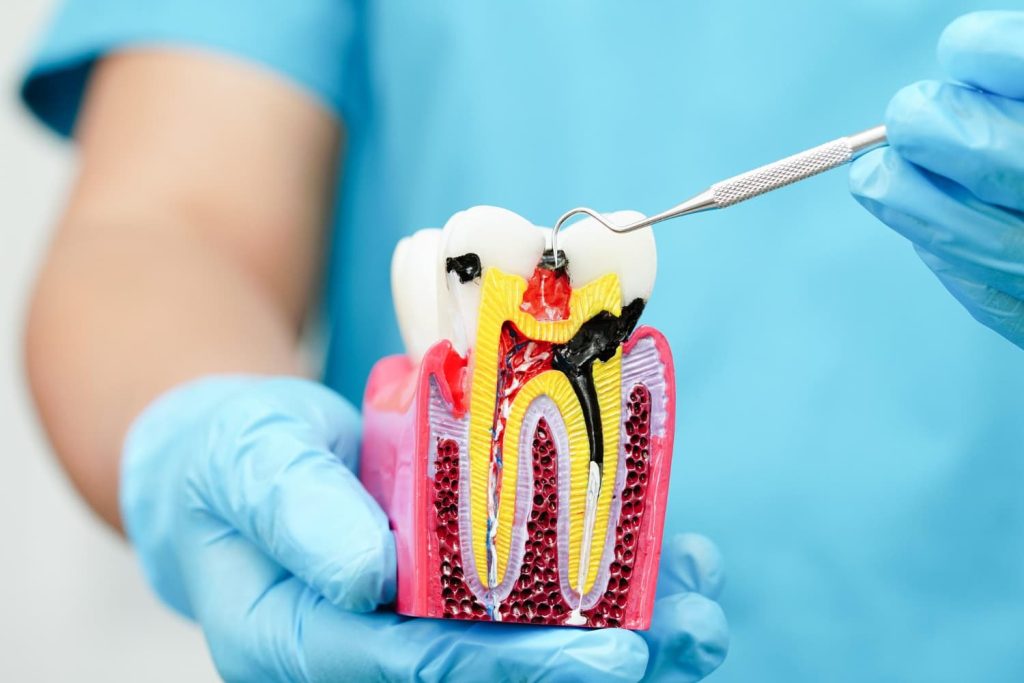

Who doesn’t feel a little apprehensive when they hear about tooth pain or infections? Think about that common situation: a pain that won’t go away, a tooth sensitive to hot or cold, or that strange pressure when chewing. More than once, I’m sure, you’ve asked yourself: Do I need a root canal ? Isn’t that too much for what I have?
The truth is that root canal treatment, far from being the villain, is often the hero that saves teeth that would otherwise end up outside your mouth. But do you know what this treatment involves, when it’s advisable, and what you can expect throughout the process? Keep reading, because relief might be closer than you think. Let us tell you: losing a tooth is never a better idea than trying to save it.
Criteria for the need for endodontics: pain, inflammation, or both
A root canal is usually necessary when symptoms such as intense pain, inflammation, or persistent discomfort related to the dental pulp appear.
Interestingly, it often starts with a minor discomfort. There it is: that pain you’re not sure whether to take seriously, that slightly swollen gum, or the heightened sensitivity of a tooth. Is it serious? Often, yes, and what’s happening is that the dental pulp, that soft, highly sensitive part in the center of the tooth, could be in trouble. However, not every pain means you need a root canal, and ignoring it rarely ends well.
How to recognize the symptoms that require endodontics?
- Constant or sharp pain, especially when biting.
- Visible swelling or lump near the tooth (the dreaded “fistula”).
- Extreme sensitivity to cold or heat, which persists longer than normal.
- Change in color of the damaged tooth.
These symptoms don’t appear out of nowhere. They usually indicate that something is wrong inside the tooth canal: inflammation or infection. That sharp pain is your body telling you: do something! And it’s tempting to think the typical “if I wait a while, it might go away,” but the truth is that rarely happens. When these signs appear, the advice is simple: seek professional help before things get worse.
Cases in which endodontics is essential
While every person is different, there are circumstances in which endodontics ceases to be an option and becomes the only reasonable solution:
- Deep caries : the caries has already passed through the barrier and reached the pulp, infecting or destroying it.
- Severe infection : pus or abscess appears due to bacteria that have invaded the root.
- Traumatic damage : a blow fractures the tooth and exposes the inner part, leaving free access for bacteria.
Ignoring these warnings would be like closing the door on a fire alarm and expecting the fire to go out on its own. It’s the same with teeth: the longer you leave it, the harder it is to fix; you might even end up losing the tooth.

Causes of pain in endodontics: inflammatory diseases
The pain that leads to needing a root canal is usually caused by inflammation and infections inside the dental pulp, almost always due to advanced caries or blows.
Every root canal has its own story: it almost always begins with a stubborn cavity that no one stopped in time, a forgotten infection, or a fracture that worsened. And, to be honest, almost no one realizes it until the pain takes center stage. But what’s happening in there when you start to feel discomfort?
Why does it hurt so much?
Here’s a quick lesson: the dental pulp, with its nerves, blood vessels, and high sensitivity, is extremely intolerant of pressure and the entry of bacteria. When a deep cavity or fracture allows germs to enter, the pulp becomes inflamed (called “pulpitis”). The result: pain that can be intense and is sometimes only relieved by a root canal.
- Deep cavities : open a direct path to infection in the center of the tooth.
- Inflammatory problems : pulpitis, pulp necrosis… conditions in which the tooth simply cannot recover on its own.
- Damage from blows or fractures : leaves the pulp exposed and vulnerable to bacteria.
You’ve probably heard the story: “It started with a mild pain, and now I can’t even sleep.” When the pulp becomes truly infected, preserving the tooth’s vitality is nearly impossible. So, at that point, the only thing that can truly save your tooth is a root canal.
Is it worth trying to save the tooth?
The short answer: yes. Whenever possible, root canal treatment is the best option compared to extraction. Keeping your natural tooth is much better for your bite, your chewing function, and for avoiding long-term problems. Most professionals would agree: your own tooth, properly treated, is worth more than any implant .
Don’t make the mistake of assuming the pain will go away on its own. If you let the infection progress, the problem can spread to other areas of your mouth, cause a fever, and even land you in the hospital. It’s better to avoid that unpleasant experience, right?
What to expect from endodontic treatment: procedures and results
Endodontics involves removing the infected pulp, cleaning the canals and sealing them to restore the tooth inside and out.
The decision to have a root canal is often accompanied by a thousand questions: Does it hurt? Will I lose the tooth? How long will it take to recover? The truth is, nowadays, the procedure is much less daunting than it seems. The goal is to relieve pain and prevent the problem from worsening.
Step-by-step endodontic procedure
- Diagnosis and anesthesia : The dentist reviews X-rays and checks for infection. Then, local anesthesia is administered so you won’t feel any pain.
- Cleaning and disinfection : a small access is opened in the tooth, the damaged pulp is removed and the canals are thoroughly cleaned, using disinfectant solutions.
- Sealing and restoration : Once cleaned, the canals are filled with special materials and sealed to prevent further infection. In most cases, the tooth is then reinforced with a crown or restoration.
Immediate benefits of root canal treatment:
- It eliminates the pain caused by the infection.
- It allows you to keep your original tooth.
- It prevents the spread of infection to the bone or other teeth.
Care after a root canal
Although root canal treatment eliminates the cause of the pain, the tooth needs a little extra care to ensure everything heals properly. Take note of these tips:
- Avoid chewing hard things for the first few days
- Maintain thorough hygiene with gentle brushing and flossing.
- Don’t skip the checkups. Professional follow-up is key to ensuring everything is perfect.
Are you thinking that, after all, your tooth’s days are numbered? Don’t worry. A well-done root canal can give you many years of peace of mind and keep your tooth healthy. The trick is to stay vigilant and follow the care and check-up plan.
Frequently asked questions about endodontics
- Does a root canal hurt? It’s usually done with local anesthesia, so the pain disappears during the procedure. You might have some discomfort afterward, but nothing compared to what you felt before.
- How long does the treatment take? It is usually completed in one or two sessions, although it depends on each case and the affected tooth.
- Is it better to extract the tooth or always try a root canal? Whenever possible, saving the tooth is the priority. Extraction is reserved for cases where there is no other way to save it.
- What are the risks? As with any treatment, there can be complications (an instrument might break, or an infection might become resistant), but these are rare in expert hands.
Endodontics, far from being a nightmare, is often the best way to end pain, save your teeth, and return to your daily peace of mind. If you listen to your body and act promptly, the experience is much more manageable than you might imagine. The key is not to ignore the symptoms and to always trust specialists.
Remember: your smile tells its own story, and there’s nothing like preserving your original teeth, battles and all. So, if you have any doubts or are nervous, consider that taking the plunge could be the decision that brings your smile back to life. At ES Dental Clinic, your dental health and well-being are our priority.